Quick answer
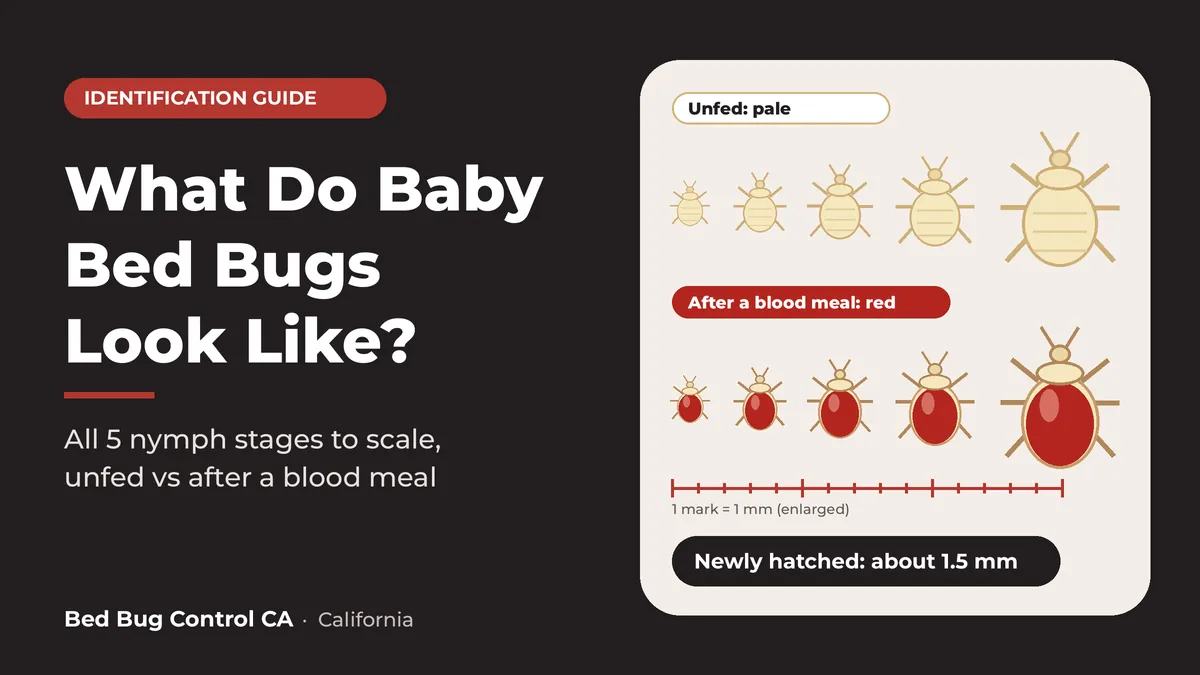
A baby bed bug (called a nymph) looks like a tiny, flat, oval copy of an adult bed bug, but it is pale, yellowish white and partly see-through until it feeds. Newly hatched nymphs are about 1.5 mm long, close to the size of a poppy or sesame seed, and they grow through 5 stages to about 4.5 mm. Right after a blood meal, a nymph swells and turns bright red, which is when it is easiest to see. Bed bugs do not have larvae. The young are nymphs that look like small adults, with 6 legs and no wings.
Tiny, pale bugs in a mattress seam are easy to brush off as lint. But baby bed bugs are one of the clearest signs that bed bugs are breeding in a home. This guide shows every nymph stage drawn to scale, how the color changes after a meal, where nymphs hide, and how to tell them from fleas, carpet beetle larvae, bat bugs and booklice.
The facts come from the EPA, the University of California IPM Program (UC IPM), Cornell University and the University of Kentucky.
Key takeaways
- Baby bed bugs are called nymphs. Bed bugs have no larvae, so the young look like small, pale adults.
- The EPA lists 5 nymph stages at about 1.5, 2, 2.5, 3 and 4.5 mm long.
- Unfed nymphs are yellowish white and see-through, and the EPA says they can be nearly invisible.
- After a blood meal, a nymph swells and turns red. As the blood is digested it looks darker.
- Finding nymphs means bed bugs are breeding. Have a licensed pro inspect the home.
What Does a Baby Bed Bug Look Like?
A baby bed bug is a young common bed bug (Cimex lectularius) that has hatched from an egg but is not grown yet. UC IPM says nymphs look the same as adults except for their smaller size, their thinner outer skin (cuticle) and their lighter, yellowish white color. The University of Kentucky describes newly hatched nymphs as straw colored and no bigger than a pinhead. Here is what to look for:
Shaped like a tiny apple seed seen from above, wider at the rear. Flat enough to slip into a crack the width of a credit card.
Unfed nymphs are clear to yellowish white or tan. Right after feeding they look bright red inside.
No wings at any age. It cannot jump or fly.
About 1.5 mm when it hatches and about 4.5 mm in the last stage, per the EPA.
If you have not seen a grown bed bug yet, compare with our guide on what a bed bug looks like. Nymphs and adults often hide together.
Bed Bug Nymph Stages and Sizes, Drawn to Scale
UC IPM explains that there are 5 nymph stages, also called instars. Each one needs at least 1 blood meal before it can molt, shed its skin and move up to the next, bigger stage.
The drawing shows all 5 stages at one enlarged scale, using the EPA sizes. The top row is unfed. The bottom row is the same nymphs after a blood meal.
| Stage | Length (EPA) | Rough comparison | What you notice |
|---|---|---|---|
| 1st stage nymph | About 1.5 mm | Between a poppy seed and a sesame seed | Pale, see-through, very hard to spot unless it has fed |
| 2nd stage nymph | About 2 mm | Smaller than a sesame seed | Still pale, a red spot inside after feeding |
| 3rd stage nymph | About 2.5 mm | Close to a sesame seed | Legs and antennae easier to see |
| 4th stage nymph | About 3 mm | About a sesame seed | Tan color, starting to look like an adult |
| 5th stage nymph | About 4.5 mm | Close to an apple seed | Darker tan, easy to mistake for an adult |
| Adult (for comparison) | About 5 mm (about 1/5 inch) | An apple seed | Rusty red to brown, darker and harder shelled |
So, how big are bed bug nymphs? UC IPM puts the whole range at about 1/20 to 1/5 inch. The smallest is close to the size of a bed bug egg, which is about 1 mm. For more size comparisons, including coins and other bugs, see how big a bed bug is.
How fast do they grow? UC IPM says egg to adult takes about 5 weeks to 4 months, fastest between 70°F and 82°F with regular meals.
What Color Are Baby Bed Bugs Before and After Feeding?
Color changes with every meal:
- Just hatched or unfed: clear, whitish yellow, straw colored or light tan. The EPA says nymphs that have not fed recently can be nearly invisible to the naked eye because of their color and size.
- Right after a blood meal: the belly swells, gets longer and fills with red blood, so the whole bug looks bright red. A bed bug identification guide from Clark County, Nevada notes that each nymph stage feeds and becomes filled with red blood.
- A few days after feeding: Cornell University explains that as the blood meal is digested, a black spot forms in the belly. The bug looks darker and less red.
That is why people often report “tiny red bugs” in the bed. A small, bright red, rounded bug in a seam is very often a nymph that just fed.
Good to know: the CDC says bed bugs are not known to spread disease. Having them does not mean a home is dirty.
Do Bed Bugs Have Larvae?
No. People often search for “bed bug larvae,” but bed bugs do not have a larval stage. They go through what entomologists call simple, or gradual, change: egg, then nymph, then adult. There is no worm-like larva and no pupa.
So if the “baby bug” you found looks like a tiny worm or a fuzzy grub, it is not a bed bug. A real nymph always has 6 legs and a flat, oval body.
Can You See Baby Bed Bugs With the Naked Eye?
Yes, but it is hard. UC IPM says you can see adults and groups of nymphs with the unaided eye, while eggs need a magnifying lens. Pale nymphs blend into light sheets, so most people notice them only after they feed and turn red.
To spot a tiny bed bug:
- Use a bright flashlight at a low angle. Small bodies cast a shadow.
- Use a magnifying glass. Legs and antennae tell a nymph from dust.
- Check in the early morning. Bed bugs feed at night, so fresh feeders are red.
- Look for clusters. Nymphs hide with eggs, shed skins and dark spots.
- Use a thin card. Slide it along seams to push hidden bugs out.
Also look for what nymphs leave behind. The EPA describes the skins nymphs shed as tiny and pale yellow. Dark spots are bed bug droppings, explained in our guide on what bed bug poop looks like.
Bed bug inspection and treatment in California
Not sure what you found? Get it confirmed.
Our licensed technicians come to you for a bed bug inspection and give you a written treatment quote. It costs nothing to call.
Where Do Baby Bed Bugs Hide?
Nymphs hide in the same places as adults, close to where people sleep. UC IPM says hiding places are usually within 6 feet of where people sleep or rest, and research it cites found about 85% of bed bugs in or near the bed. Bed bugs also prefer wood, paper and fabric over metal or plastic.
- Mattress seams, piping, tags and tufts
- Box spring wood frame, under the dust cover
- Bed frame joints, slats, screw holes and headboard cracks
- Couch and recliner seams and under cushions
- Nightstand drawer joints and baseboards near the bed
- Behind outlet covers, loose wallpaper and picture frames
The EPA notes that if a crack will hold a credit card, it could hide a bed bug, and nymphs are even thinner. They often sit right next to eggs and empty shells. Our guides on what bed bug eggs look like and how long bed bug eggs take to hatch explain what comes before the nymph stage.
Baby Bed Bugs vs Look-Alikes: Fleas, Carpet Beetle Larvae, Bat Bugs and Booklice
Several small household bugs get mistaken for baby bed bugs. The University of Kentucky notes bed bugs are sometimes confused with ticks, cockroaches and carpet beetles. Shape, movement and location tell you the most.
| Bug | Size | Shape and color | How it moves | Where you find it |
|---|---|---|---|---|
| Bed bug nymph | About 1.5 to 4.5 mm | Flat, oval, pale yellowish white, red after feeding | Crawls, cannot jump or fly | Mattress seams, bed frames, couches |
| Flea | Up to about 1/8 inch (3 mm) | Reddish brown, flattened side to side, like it walks on edge | Jumps far and fast | Where pets sleep, on pets, carpet |
| Carpet beetle larva | Up to about 5/16 inch (8 mm) | Fuzzy, hairy, worm-like, often striped tan and brown | Crawls slowly | Closets, rugs, wool, under furniture |
| Bat bug | Close to bed bug size | Looks almost the same as a bed bug, with longer hairs behind the head | Crawls | Usually linked to bats roosting in the building |
| Booklouse | About 1 to 2 mm | Soft, pale tan to nearly clear, large head with a bulging “nose” | Runs quickly | Damp spots, old books, paper, stored food |
Dark and thin from side to side. They jump and gather where pets sleep.
UC IPM calls them fuzzy or hairy maggots. They eat wool, silk and leather, not blood.
UC IPM says their hairs behind the head are longer than the eye is wide. A pro needs a lens to tell.
Penn State Extension says they are soft, feed on mold in damp places and do not bite.
Bites look alike too. See bed bug bites vs flea bites.
Quick Check: Is It a Baby Bed Bug?
Look at the bug with a flashlight and a magnifying glass, then tick every true statement. Nothing is saved.
This checklist is a quick guide, not a diagnosis. Only a trained inspector can confirm bed bugs for sure.
What to Do If You Find Baby Bed Bugs
Finding nymphs means bed bugs are breeding in the home. Each one hatched from an egg laid nearby and needs blood to grow. If you found just one bug, read what to do if you found one bed bug.
Do
- Catch a sample on clear tape or take a sharp photo next to a ruler.
- Bag bedding and clothes in the room and dry them on high heat.
- Vacuum seams slowly, then seal the bag and put it in an outdoor trash bin.
- Keep sleeping in your own bed so the bugs do not spread.
- Book an inspection with our licensed technicians.
Do NOT
- Set off foggers or bug bombs. The EPA warns too many can cause a fire or explosion.
- Use rubbing alcohol, kerosene or gasoline. The EPA says these can easily ignite.
- Spray outdoor pesticides inside. The EPA says this can make a home unlivable.
- Use pool-grade or food-grade diatomaceous earth. The EPA says it should not be used.
- Drag the mattress or furniture through the home unwrapped.
The EPA says a clothes dryer on high heat can help, steam must be at least 130°F, and interceptor cups under the bed legs should be checked every week. But nymphs keep hatching from hidden eggs. Our guide on how to get rid of bed bugs covers the full plan. Most homes need a licensed professional:
K9 inspectionDogs sniff out bugs too small to find by eye.
Heat treatmentKills all life stages, eggs included.
Chemical treatmentTargeted products plus follow-up visits for late hatchers.
In California, only licensed pest control operators may do this work. You can verify a company’s license with the Structural Pest Control Board.
If You Rent in California
California’s bed bug law, AB 551 (California Civil Code sections 1954.600 to 1954.605), protects renters:
- Landlords must give tenants written information about bed bugs and how to report them.
- A landlord cannot show or rent a vacant unit they know has a current infestation.
- After a pest control inspection, the landlord must share the findings with affected tenants in writing within 2 business days.
- Tenants must cooperate with inspection and treatment.
If you find nymphs, tell your landlord or property manager in writing, include your photos and keep a copy.
Frequently Asked Questions
What does a baby bed bug look like?
A baby bed bug, or nymph, looks like a tiny, flat, oval adult bed bug with 6 legs and no wings. It is pale and see-through until it feeds, then bright red.
How big are baby bed bugs?
The EPA lists the 5 nymph stages at about 1.5, 2, 2.5, 3 and 4.5 mm long. The last stage is nearly adult size.
Do bed bugs have larvae?
No. Bed bugs go from egg to nymph to adult, with no larva or pupa. A worm-like or fuzzy baby bug is something else.
Can you see baby bed bugs with the naked eye?
Yes, but they are hard to spot. The EPA says unfed nymphs can be nearly invisible because of their pale color and small size. A flashlight and magnifying glass help.
What color are baby bed bugs after they feed?
Right after a blood meal, nymphs look bright red and swollen. As the blood is digested, Cornell University notes a black spot forms in the belly, so they look darker.
Do baby bed bugs bite?
Yes. UC IPM says each nymph stage needs at least 1 blood meal before it can molt to the next stage. Nymph bites look the same as adult bites. See a doctor if a reaction is severe or looks infected.
What can be mistaken for baby bed bugs?
Fleas, carpet beetle larvae, bat bugs and booklice are common look-alikes. Fleas jump, carpet beetle larvae are fuzzy and booklice live in damp spots.
Does finding baby bed bugs mean an infestation?
Usually, yes. Nymphs hatch from eggs laid nearby, so finding them means bed bugs are breeding in the home. Have a licensed pro inspect the home.
Bed Bug Control CA
Found baby bed bugs? Stop them before they grow up.
Call our team and we will set up a bed bug inspection in your California city, then give you a written quote.
Bed Bug Control CA provides bed bug inspection and treatment. Our licensed technicians perform the treatments.
Sources
- US Environmental Protection Agency (EPA), Bed Bugs: Appearance and Life Cycle
- US Environmental Protection Agency (EPA), How to Find Bed Bugs
- US Environmental Protection Agency (EPA), Do-it-yourself Bed Bug Control
- US Environmental Protection Agency (EPA), Stay Legal and Safe When Treating Bed Bugs
- University of California IPM Program, Bed Bugs Pest Notes
- University of California IPM Program, Fleas Pest Notes and Carpet Beetles Pest Notes
- Cornell University IPM, Identifying Bed Bugs
- University of Kentucky Entomology, Bed Bugs (ENTFACT-636)
- Penn State Extension, Booklice
- Clark County, Nevada, Bed Bug Identification Guidelines
- Centers for Disease Control and Prevention (CDC), About Bed Bugs
- California Structural Pest Control Board
- California Civil Code sections 1954.600 to 1954.605 (AB 551)