Quick answer
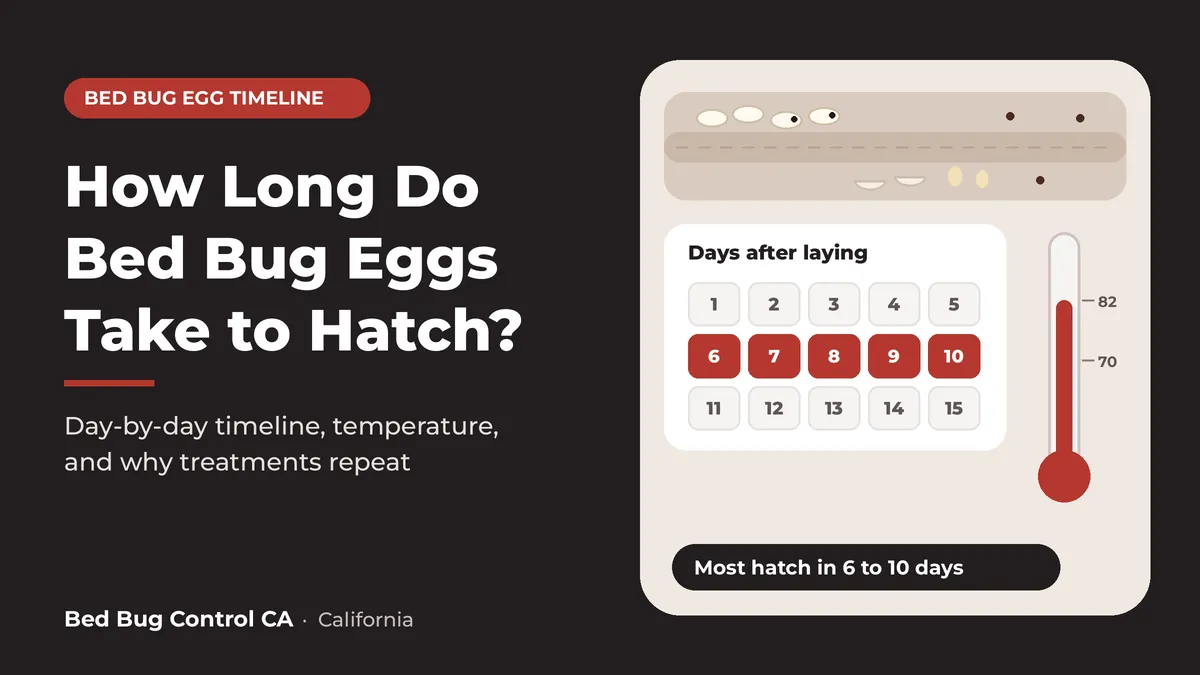
At normal room temperature, bed bug eggs take about 6 to 10 days to hatch, and almost all hatch within about 2 weeks. Virginia Tech researchers found about 60% hatch by day 6 and over 90% by day 9 when rooms stay above 70°F. Cooler rooms add several days, and eggs held steadily below about 55°F could not finish hatching in a classic lab study. This is why bed bug treatments are usually repeated about 2 weeks apart: the second visit catches the young bugs that hatch from eggs the first visit missed.
Just found bed bugs, or just had your home treated? Knowing how long it takes for bed bug eggs to hatch tells you when to expect new bugs, how long to keep watching and why one treatment is rarely enough.
Our team works on bed bug jobs across California every day, and “I saw a tiny bug a week after treatment” is a common worry. Below is the day-by-day timeline, how temperature changes it and what it means for treatment, using figures from university entomologists and the EPA.
Key takeaways
- Most bed bug eggs hatch in about 6 to 10 days at room temperature. Expert guides give ranges from about 5 to 15 days.
- A dark eye spot shows on eggs older than about 5 days, a sign hatching is close.
- Warm rooms (about 70°F to 82°F) are fastest. Cool rooms slow hatching by several days.
- Eggs do not hatch all at once. Females lay a few each day, so new nymphs keep appearing over time.
- Follow-up treatments about 2 weeks apart catch bugs that hatch after the first visit, before they can lay eggs.
- A cold garage or car is not a reliable way to kill eggs. In lab tests, cool eggs survived for weeks.
How Long Does It Take for Bed Bug Eggs to Hatch?
The common bed bug (Cimex lectularius) lays pearly white eggs about 1 mm long, about the size of a pinhead, according to the EPA. They are glued into seams and cracks near where people sleep.
Virginia Tech entomologists Dini Miller and Andrea Polanco report that at room temperature above 70°F, about 60% of eggs hatch by the time they are 6 days old, and more than 90% have hatched by day 9. The EPA notes that eggs more than 5 days old show a small dark eye spot, which is the developing bug inside. Here is that timeline day by day:
So the short answer to “how long do bed bug eggs take to hatch” is about 1 week in a warm home, and up to about 2 weeks depending on conditions. When the egg hatches, the young bug, called a first stage nymph, pushes open a small cap at one end and crawls out. UC IPM notes the empty eggshells often stay stuck in place afterward.
Why Sources Give Different Hatch Times
You will see “6 to 10 days”, “about a week” and “10 to 15 days”. They are not really in conflict. Each source used a slightly different “room temperature”, and even one batch of eggs hatches over several days.
| Source | Hatch time stated | Conditions and notes |
|---|---|---|
| Virginia Tech | About 60% by day 6, over 90% by day 9 | Room temperature above 70°F. Cooling the room adds several days. |
| University of Kentucky | About a week | Room temperature. Cooler rooms prolong development. |
| Penn State Extension | 5 to 10 days | Room temperature. |
| UC IPM (University of California) | About 10 to 15 days | Room temperature. Development is fastest between 70°F and 82°F. |
| Johnson, 1940 lab study | No hatching outside about 55°F to 99°F | Eggs held at constant temperatures. Humidity did not change how long eggs took. |
| Practical answer | Plan for about 2 weeks | Most eggs hatch within 10 days, but a cool room can stretch it. |
For planning, the safest rule is simple: any egg in your home today will most likely have hatched within about 2 weeks, and sooner if your home is warm.
How Temperature Changes Bed Bug Egg Hatch Time
Temperature is the biggest factor. Eggs develop faster when it is warm and slower when it is cool. UC IPM says development is fastest between 70°F and 82°F, the range most homes are kept at. Tap each range to see what happens.
This is the ideal range for bed bugs. Most eggs hatch in about 6 to 10 days, and Virginia Tech found over 90% hatched by day 9. Most California homes sit in this range much of the year.
Virginia Tech notes that lowering the room temperature can add several days to hatch time. A cool spare bedroom or a home with the heat off in winter may see eggs hatch closer to 2 weeks or more.
In Johnson’s lab study, eggs kept at a constant temperature below about 55°F (13°C) could not finish developing and hatch. Many still survived for weeks, so cold delays the problem rather than solving it.
The same study found eggs could not complete hatching at a constant temperature above about 99°F (37°C). Much higher heat, like a professional heat treatment, kills eggs outright. UC IPM says heat treatments hold rooms at about 130°F to 140°F for hours.
Ranges are simplified from the cited studies. Real rooms change temperature through the day, which can speed or slow eggs.
Turning your thermostat up or down will not fix an infestation. A warm room only means eggs hatch on a faster schedule, and a cold room just delays them. Killing eggs with heat takes the kind of temperatures UC IPM describes for professional heat treatment, about 130°F to 140°F held for hours, far beyond what a thermostat or space heater can safely do.
Do Bed Bug Eggs Hatch All at Once?
No, and this is the part most guides skip. UC IPM says a female lays about 2 to 5 eggs per day and 200 to 500 eggs over her life. The University of Kentucky adds that females need to feed now and then to keep laying. So in an active infestation, eggs are being laid almost every day, and each one is on its own 1 to 2 week clock.
So hatching is a steady trickle, not a single event. One mattress seam can hold fresh eggs, eggs with eye spots, empty shells and new nymphs at the same time, and one hatched shell does not mean hatching is over.
It also explains a common pattern after treatment: bites slow down, then a week or so later a few tiny, pale bugs appear. Those usually hatched from eggs already in the room, not from a new infestation.
How to Tell If Bed Bug Eggs Have Hatched
UC IPM notes that seeing eggs usually requires a hand lens. Use one with a flashlight along seams and cracks, and read what you find like this:
- Unhatched, fresh: glossy, pearly white and plump, about 1 mm long. These still have days to go.
- Unhatched, close to hatching: still white and plump, but with a small dark eye spot near one end. The EPA says this means the egg is more than 5 days old.
- Hatched: empty, flattened, see-through or dull white shells, often open at one end. They stay glued in place after the nymph leaves.
- Nearby nymphs: tiny pale bugs about 1.5 mm long, near or behind the shells, which the EPA notes can be nearly invisible when unfed.
For close-up pictures and look-alikes such as lint, salt and lice nits, see our guide on what bed bug eggs look like. If you are not sure whether a bug is a bed bug at all, compare it with our photos of what a bed bug looks like.
Tip: Old shells can stay stuck for a long time. Plump eggs and live bugs are stronger signs of an active problem.
Can Bed Bug Eggs Wait Out a Cold Garage, Car or Storage Unit?
Many people plan to leave infested items in a garage, car or storage unit “until the eggs die”. That is risky. In Johnson’s 1940 study, eggs exposed to cool temperatures survived for a long time. At about 54°F (12°C), the estimated time needed to kill 99.99% of the eggs was close to 80 days.
A cool California garage in winter mostly pauses eggs rather than killing them, and they can pick up again back in a warm bedroom. Texas A&M AgriLife Extension also notes that killing bed bugs by simply sealing items in bags takes 2 to 5 months.
Parked cars swing between hot and cool, so you cannot count on them either. Bagging items in the room and treating them with proven methods is safer. Our guide on how to get rid of bed bugs covers safe heat, dryer and steam steps.
Why Bed Bug Treatments Are Repeated About 2 Weeks Apart
Eggs are hard to reach and hard to kill. Texas A&M notes that vacuums do not remove eggs well and alcohol-based sprays do not kill them, so repeat treatments are usually needed. The hatch timeline sets the follow-up schedule.
Here is the logic. Virginia Tech found that going from egg to egg-laying adult takes about 37 days even in warm rooms, and UC IPM gives 5 weeks to 4 months depending on temperature and food. So a follow-up around day 14:
- Comes after the hatch. Most eggs left behind on day 0 have hatched by about day 10 to 15, so the new nymphs are now out in the open where treatment can reach them.
- Comes before they breed. Those nymphs are still weeks away from becoming adults that can lay a new round of eggs.
- Checks the results. Interceptor cups and a fresh inspection show whether the first visit worked or whether a spot was missed.
In an apartment field study led by entomologist Changlu Wang, units were checked every 2 weeks over 8 weeks, and cleared units needed an average of 2 visits. Schedules vary by company and method, so ask your pro when the follow-up is. Whole-room heat kills eggs directly, but monitoring afterward still matters.
Bed bug inspection and treatment in California
Want a treatment plan that covers the egg stage?
Our licensed technicians come to you for a bed bug inspection, a treatment quote and a clear follow-up schedule. It costs nothing to call.
How Long to Keep Watching After Treatment
Because eggs can take up to about 2 weeks to hatch, and longer in a cool room, a quiet first week does not mean you are done. The EPA says to check every few days after cleanup, and then at least every 7 days in case any eggs remain. If bugs still turn up, it says either the cleanup missed some bugs or eggs have hatched, and you may need to treat again.
Do during the egg window
- Keep sleeping in your own bed so bugs do not spread
- Check interceptor cups under the bed legs at least weekly
- Keep mattress and box spring encasements zipped on
- Note the date and spot of every bug you find
- Keep the follow-up appointment even if things look quiet
Don’t during the egg window
- Panic over 1 or 2 tiny pale bugs in the first 2 weeks
- Move belongings to other rooms or a friend’s house
- Vacuum or clean away a pro’s treatment without asking
- Bring infested items back from the garage too early
- Declare victory after a few bite-free nights
Bites are a poor guide, since reactions can show up days later. Our guide on how long bed bug bites last explains how to tell healing bites from new ones. A few small nymphs in the first 2 weeks are expected. Bugs that keep showing up after that mean you should call your pro back.
What NOT to Do About Bed Bug Eggs
Knowing eggs will hatch soon pushes people toward fast but harmful fixes. Avoid these:
- Foggers or bug bombs. They do not reach eggs hidden in cracks. The EPA says too many at once can cause a fire or explosion.
- Rubbing alcohol, gasoline or kerosene. The EPA says rubbing alcohol has caused numerous house fires, and these liquids can ignite with a spark. Texas A&M notes alcohol sprays do not kill eggs anyway.
- Outdoor or farm pesticides indoors. The EPA warns these can make your home dangerous and unlivable. Use only EPA-registered products labeled for bed bugs, exactly as the label says.
- Pool-grade diatomaceous earth. The EPA says pool or food grade diatomaceous earth should not be used.
- Cranking the heat or relying on a cold garage. Neither reaches a temperature that reliably kills eggs. It just changes when they hatch.
- Skipping the follow-up. Stopping after 1 visit leaves the eggs that were already there free to hatch and grow.
Safety first: if anyone feels dizzy, sick or has trouble breathing after a pesticide was used, get them to fresh air and call Poison Control at 1-800-222-1222, or 911 in an emergency. For a severe skin reaction to bites, talk to a doctor.
In California, bed bug treatment for hire must be done by a company licensed by the Structural Pest Control Board, and you can verify a license on its website. For anything more than a few bugs in 1 bed, a licensed pro is the most reliable way to deal with eggs you cannot see. If bites are bothering you, see our photo guide to what bed bug bites look like.
If You Rent in California
The egg window matters for renters too. California’s bed bug law, AB 551 (California Civil Code sections 1954.600 to 1954.605), sets rules for rentals:
- Landlords must give tenants written information about bed bugs and how to report them.
- After a pest control inspection, the landlord must tell affected tenants the findings in writing within 2 business days.
- A landlord cannot show, rent or lease a vacant unit they know has a current bed bug infestation.
- Tenants must cooperate with inspection and treatment.
Report bed bugs to your landlord in writing with photos, and keep a copy. If you see new bugs in the weeks after treatment, report those in writing too, with dates. This is general information, not legal advice.
Frequently Asked Questions
How long does it take for bed bug eggs to hatch?
About 6 to 10 days at normal room temperature, and almost all hatch within about 2 weeks. Virginia Tech found about 60% hatch by day 6 and over 90% by day 9 above 70°F. Cooler rooms add several days.
How long do bed bug eggs take to hatch in a cold room?
Longer. Cooling a room can add several days to hatch time. In a 1940 lab study, eggs held at a constant temperature below about 55°F could not finish hatching, but many survived for weeks.
Do all bed bug eggs hatch at the same time?
No. A female lays about 2 to 5 eggs a day, so eggs in a home are all at different ages. New nymphs keep hatching day after day in an active infestation.
How can you tell if a bed bug egg is about to hatch?
Look for a small dark eye spot near one end of the egg. The EPA says this shows the egg is more than 5 days old, so hatching is usually only days away at room temperature.
Why do bed bug treatments need a follow-up 2 weeks later?
Eggs are hard to kill, so some survive the first visit. By about 2 weeks most have hatched, and the new nymphs can be treated before they grow into adults that lay more eggs.
Is it normal to see bed bugs a week after treatment?
A few small, pale nymphs in the first 2 weeks are common, since they hatch from eggs that were already there. Bugs that keep showing up after that, or adult bugs, mean you should call your pro back.
Can bed bug eggs survive in a cold garage or car?
Often, yes. In lab tests, eggs at about 54°F took close to 80 days to be almost all killed. A cool garage usually just delays hatching, and a car’s temperature swings too much to rely on.
Do bed bug eggs need blood to hatch?
No. Eggs hatch on their own based mostly on temperature. The female needs blood meals to keep laying eggs, and the newly hatched nymph needs a blood meal to grow.
Bed Bug Control CA
Get ahead of the next hatch.
Call our team and we will set up a bed bug inspection in your California city, then give you a written quote.
Bed Bug Control CA provides bed bug inspection and treatment. Our licensed technicians perform the treatments.
Sources
- Miller and Polanco, Virginia Tech Department of Entomology, Bed Bug Biology and Behavior
- University of California IPM Program, Bed Bugs Pest Notes
- University of Kentucky Entomology, Bed Bugs (ENTFACT-636)
- Penn State Extension, Biology, Habitat and Management of Bed Bugs
- Johnson, C. G. (1940), Development, hatching and mortality of the eggs of Cimex lectularius, Parasitology 32(2)
- US Environmental Protection Agency (EPA), Bed Bugs: Appearance and Life Cycle
- US Environmental Protection Agency (EPA), Do-it-yourself Bed Bug Control
- US Environmental Protection Agency (EPA), Stay Legal and Safe When Treating Bed Bugs
- Texas A&M AgriLife Extension, Bed Bugs: Do-it-yourself Control Options
- Wang, Abou El-Nour and Bennett (2007), Controlling Bed Bugs in Apartments
- California Structural Pest Control Board
- California Civil Code sections 1954.600 to 1954.605 (AB 551)