Quick answer
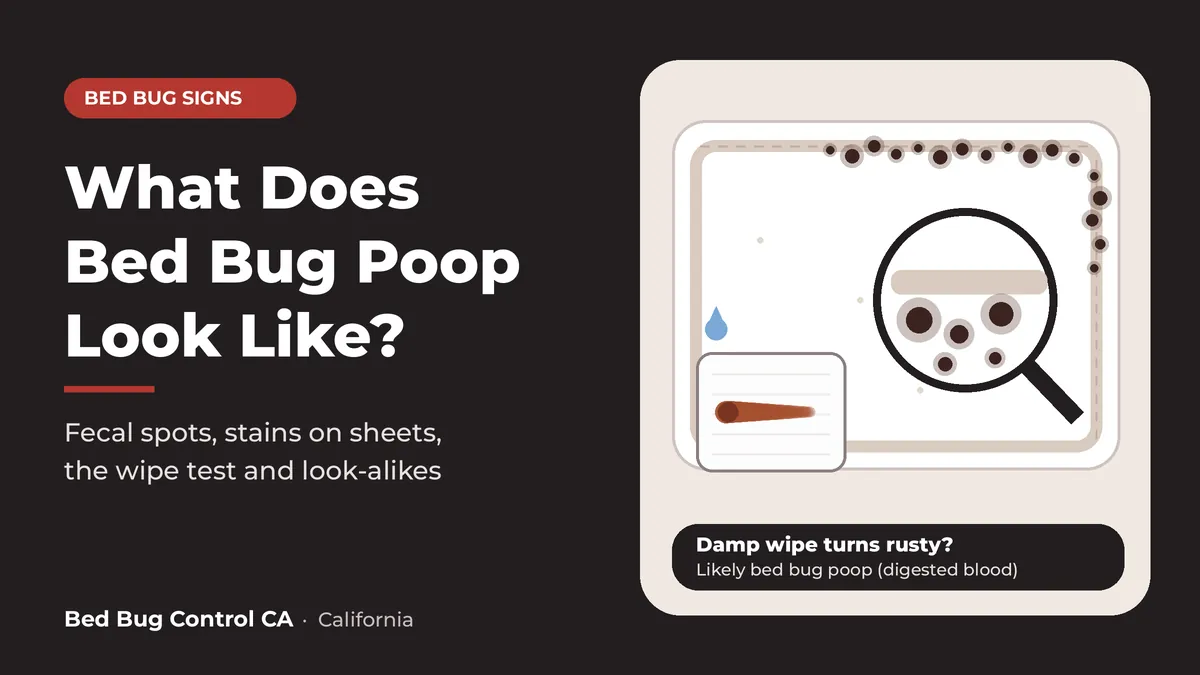
Bed bug poop looks like tiny dark dots, about the size of a printed period, in black, dark brown or rusty red. On sheets and mattress fabric the dots soak in and blur at the edges like a felt-tip marker. On wood or plastic they stay as small, smooth spots. The spots are digested blood, so if you rub one with a damp tissue it leaves a rusty smear. You usually find them in clusters along mattress seams, the box spring, the headboard and the bed frame.
Most people never see a bed bug at first. What they see is a few odd black specks on the fitted sheet or a dark line of dots along the mattress seam. Those specks are often the first real clue, and they are easy to mix up with mold, dirt, flea dirt or cockroach droppings.
This guide shows how the spots look on different surfaces, how to test one at home, what they say about the problem and how to clean them safely. It is based on the EPA, the University of California and other university experts.
Key takeaways
- Bed bug poop is dried, digested blood. It shows up as dark dots, often in groups.
- On fabric the dots bleed like a marker. On hard surfaces they stay small and smooth.
- A damp tissue turns rusty when you wipe a real bed bug spot. Dirt and mold do not do that.
- Flea dirt also turns red when wet, so check where you found it and look for other signs.
- A stain alone cannot prove you have bed bugs now. Look for eggs, shed skins and live bugs.
- Photograph the spots before you clean them, and never move bedding to another room unbagged.
What Does Bed Bug Poop Look Like?
Bed bugs (Cimex lectularius) feed only on blood. Adults and nymphs digest each meal and pass the waste as a semi-liquid that dries into a spot. Virginia Tech entomologists say the spots are black rather than red because the blood has already been digested. The University of California (UC IPM) describes them as reddish brown or dark brown to black, sometimes yellowish, and roughly round.
The EPA gives the simplest size guide: the dark spots are about the size of this dot (•), and they may bleed on fabric like a marker would. On a sheet, a group of them looks like someone tapped a pen over and over.
4 things to check on any spot:
Black, dark brown or rusty red. Fresh spots on light sheets can look reddish at the edges.
About the size of a printed dot or a pen tip. On fabric a spot can spread a little wider.
Clusters, lines and groups. Virginia Tech notes they are often seen in groups of 10 or more.
Smooth, because it is dried liquid. Cockroach droppings feel grainy, per Virginia Tech.
Spots often sit next to eggs, which are about 1 mm long and pale. See what bed bug eggs look like. A “buggy” smell is a poor clue: the University of Kentucky says it is seldom noticeable except in extreme cases.
What Bed Bug Stains Look Like on Sheets, Mattresses, Wood and Walls
On sheets and pillowcases
Expect small black or brown dots, sometimes with a faint rusty halo where the liquid soaked in. Check the corners and the fitted sheet’s elastic edge, closest to the seams. Longer rusty or reddish smears are different: the EPA says they come from crushed bed bugs, and the CDC lists rusty-colored blood spots as a sign too.
On the mattress and box spring
Look along the piping, seams and tags. The University of Kentucky calls dark spots here a telltale sign. Spots often line up along a seam or collect in a corner, and the stapled fabric under a box spring can hold many.
On wood, headboards and bed frames
Wood and metal do not soak up liquid, so spots stay small, tight and dark. Look in joints, screw holes and cracks. UC IPM notes bed bugs fit into cracks as thin as a credit card, and spots build up at the edges.
On walls, outlets and baseboards
Spots here usually mean the bugs have spread beyond the bed. Virginia Tech lists baseboard tops, carpet edges, where wall meets ceiling, behind pictures, outlet plates and curtain seams near the rod. On paint the dots look like dark flecks.
How to Test a Spot: The Damp Wipe Test
Cornell University’s IPM program suggests a simple check: wipe the spot with a wet tissue, and if the tissue turns rusty, you are probably looking at bed bug poop. It works because the spot is digested blood.
- Use good light. Hold a flashlight low to the surface. UC IPM also suggests a small mirror for seams and undersides.
- Dampen something white. A tissue, paper towel or cotton swab with a little plain water.
- Press, then wipe. Hold it on the spot for a second, then drag it across in one direction.
- Read the color. A rusty or reddish brown streak points to bed bug waste. No rusty color points to something else.
- Feel a dry spot too. Virginia Tech says bed bug spots feel smooth, while German cockroach droppings feel grainy.
- Look for backup evidence. Check the same area for eggs, pale shed skins (cast skins left by growing nymphs) and live bugs. Cornell calls the wipe test a first step, not proof.
- Save what you find. Photograph spots next to a coin for scale, and stick any bug or skin to clear tape.
One catch: flea dirt also turns red when wet. Red smears from pepper-like specks on pet bedding point to fleas.
Bed Bug Poop vs Mold, Blood Spots, Flea Dirt and Roach Droppings
Tap each stain below to see how it looks and what the damp wipe test shows.
Black to dark brown dots about the size of a pen tip, in clusters near seams and cracks. On fabric they blur like marker ink. A damp wipe turns rusty.
A rusty or reddish smear, longer than a dot, on sheets or pajamas. The EPA links these to crushed bugs. It is a different sign from poop but points to the same problem.
Dark specks the size of pepper grains, often where pets sleep. Oklahoma State University explains that flea dirt turns red with a drop of water, so the wipe test cannot rule it out. Location and pets are the clue.
Pepper-like specks that look a lot like bed bug spotting, the University of Kentucky notes, but they feel grainy and do not smear rusty. Look in kitchens, bathrooms and near food, not on the bed.
Patches or blotches rather than separate dots. The EPA notes mold comes in many colors, including white and black, and grows on surfaces that stay wet. It does not leave a rusty smear.
The same differences side by side:
| Stain | Looks like | Feel | Damp wipe | Usually found |
|---|---|---|---|---|
| Bed bug poop | Black or dark brown dots, blurred on fabric, in groups | Smooth | Rusty smear | Mattress seams, box spring, headboard, bed frame |
| Crushed bed bug blood | Rusty or reddish smear, not a round dot | Flat stain | Reddish | Sheets, pillowcases, pajamas |
| Flea dirt | Dark specks like ground pepper | Dry, loose | Turns red | Pet beds, rugs, where pets rest |
| Cockroach droppings | Pepper-like specks | Grainy | No rusty smear | Kitchens, bathrooms, cabinets |
| Mold | Patches in many colors, often spreading | Varies | No rusty smear | Damp walls, behind furniture, under carpet |
Think a bug, not just a stain, is the problem? Compare it with our guide on what a bed bug looks like, which covers bat bugs, carpet beetles and other look-alikes.
Where to Look for Bed Bug Fecal Spots, Room by Room
UC IPM reports that about 85% of bed bugs are found in or near the bed, so start there and work outward. Spots mark where the bugs rest.
- The mattress. Piping, seams, tags, corners and the underside.
- The box spring. Top seam, corners and the fabric and frame underneath.
- The bed frame and headboard. Joints, screw holes, slats and the back of the headboard.
- Next to the bed. Nightstand drawers and joints, items stored under the bed, and the carpet edge along the wall.
- The rest of the bedroom. Baseboards, outlet plates, picture frames, loose wallpaper and curtain seams near the rod.
- Couches and chairs. Seams, zippers and undersides. UC IPM lists upholstered furniture as a common spot after beds.
Bed bug inspection and treatment in California
Not sure what those spots are?
Our licensed technicians come to your home for a bed bug inspection. It costs nothing to call.
What Bed Bug Spots Tell You About the Size of the Problem
Virginia Tech notes that a light infestation may leave only 1 or 2 spots in a place, while groups of 10 or more are common. Where the spots are matters as much as how many.
Keep 2 limits in mind:
- Old spots can fool you. Dried spots stay until cleaned, so stains on a used mattress may be from a past problem. UC IPM says an infestation is confirmed only by finding the bugs or their signs, such as fecal spots, egg cases and shed skins. Look for more than one kind.
- No spots does not mean no bugs. The University of Kentucky notes visual inspection alone can miss bed bugs. UC IPM cites research where interceptor cups under bed legs caught 6 times more bugs than people found by looking.
A simple tracking trick: once you have photos, clean a small marked area of the seam. If new dots show up there over the next week or two, the bugs are still active.
How to Clean Bed Bug Stains Without Spreading the Bugs
Cleaning removes the stain, not the bed bugs. Do it in a way that also kills bugs in the fabric and keeps them in the room.
- Photograph first. An inspector or your landlord may want to see the spots.
- Bag bedding in the room. Seal sheets and blankets in a plastic bag there, then carry it straight to the washer.
- Treat the stain in cold water first. For blood stains, Mississippi State University Extension says to soak in cold water for 30 minutes, rub detergent into what is left, rinse and wash. If the stain is still there, rewash with a bleach that is safe for the fabric.
- Then use heat to kill bugs. UC IPM recommends washing bedding in hot water (120°F) and drying on the hottest setting, with at least 10 to 15 minutes of high heat. Check that the stain is gone before drying.
- Spot clean the mattress lightly. Dab stains with a cloth dampened in cold water and a little detergent. Do not soak it.
- Vacuum seams and cracks. UC IPM notes one pass rarely gets all bugs and eggs, so repeat it. Seal the contents in plastic and put them in an outdoor bin.
- Encase the mattress and box spring. Encasements trap bugs inside and give you a smooth surface where new spots are easy to see.
On a bed frame or nightstand, wipe spots with soapy water, then vacuum the cracks. For the full plan, see how to get rid of bed bugs.
What NOT to Do When You Find Bed Bug Stains
Do
- Photograph the spots with something for scale
- Do the damp wipe test and look for eggs and skins
- Keep bedding bagged until it goes in the wash
- Keep sleeping in your own bed
- Tell your landlord in writing if you rent
Don’t
- Clean everything before anyone has seen it
- Carry loose sheets through the home
- Sleep on the couch or in another room
- Spray pesticide on the mattress or bedding
- Drag the mattress to the curb unwrapped
- Do not reach for rubbing alcohol. The EPA says rubbing alcohol used against bed bugs has caused numerous house fires.
- Do not use foggers or outdoor sprays. The EPA warns that too many foggers can cause a fire or explosion, and outdoor pesticides can make a home dangerous and unlivable.
- Do not treat a bed unless the label allows it. The EPA says never to apply a pesticide to a bed, furniture or clothing if those surfaces are not on the label.
When to Get a Professional or K9 Bed Bug Inspection
Call for an inspection if the wipe test turns rusty, spots come back after cleaning, you find spots off the bed, or you get bites you cannot explain. Bites alone do not prove bed bugs. Our guide to what bed bug bites look like explains why.
K9 inspectionDogs trained on bed bug scent can help find hidden or early infestations, especially in apartments.
UC IPM says canine detection can be effective, but accuracy in real homes has varied, so ask whether the dog team has third-party certification and ongoing training.
In California, only licensed pest control operators may do pest control work for hire. You can check a company’s license with the Structural Pest Control Board before you book.
If You Rent in California
California’s bed bug law, AB 551 (California Civil Code sections 1954.600 to 1954.605), covers rentals:
- A landlord cannot show, rent or lease a vacant unit they know has a current bed bug infestation.
- Landlords must give tenants written information about bed bugs and how to report them.
- After a pest control inspection, the landlord must tell affected tenants the findings in writing within 2 business days.
- Tenants must cooperate with inspection and treatment.
Send the landlord a written report with dated photos of the spots and keep a copy. In an apartment, nearby units may need checking too.
Frequently Asked Questions
What does bed bug poop look like?
Small black, dark brown or rusty dots about the size of a printed period. On fabric they soak in and blur like marker ink. On wood or plastic they stay small and smooth. They usually appear in clusters along mattress seams and bed frames.
What does bed bug poop look like on sheets?
Tiny dark dots or clusters, sometimes with a faint rusty edge where they soaked into the fabric. They show up best on light sheets, often near the corners and the fitted sheet’s elastic edge. Longer rusty smears are usually from crushed bugs.
How can I tell if a stain is bed bug poop?
Wipe it with a damp white tissue. A rusty or reddish brown smear suggests bed bug waste, because it is digested blood. Then look nearby for eggs, shed skins or live bugs to confirm it.
How big are bed bug stains?
Each fecal spot is about the size of a pen tip or a printed dot. On fabric it can spread a little wider. Stains from crushed bugs are usually longer smears rather than dots.
Is it bed bug poop or mold?
Bed bug poop is separate dots in groups near where bugs hide, and it leaves a rusty smear when wiped. Mold forms patches in many colors on damp surfaces and does not leave a rusty smear.
Do bed bug stains mean I have an active infestation?
Not always. Dried spots stay until cleaned, so they can be left over from a past problem. Look for live bugs, eggs or new spots after cleaning, or book an inspection to be sure.
How do you clean bed bug poop stains?
Soak fabric in cold water for 30 minutes, rub in detergent, rinse and wash. Then dry on the hottest setting to kill any bugs. Bag bedding in the room first, and spot clean mattresses lightly without soaking them.
Bed Bug Control CA
Found spots? Get them checked by a pro.
Call our team and we will set up a bed bug inspection in your California city, then give you a written quote.
Bed Bug Control CA provides bed bug inspection and treatment. We inspect and treat homes with our own team.
Sources
- US Environmental Protection Agency (EPA), How to Find Bed Bugs
- US Environmental Protection Agency (EPA), Stay Legal and Safe in Treating for Bed Bugs
- University of California IPM Program, Bed Bugs Pest Notes
- Centers for Disease Control and Prevention (CDC), About Bed Bugs
- Cornell University, New York State IPM, Identifying Bed Bugs
- Virginia Tech, Miller and Rogers, How to Identify a Bed Bug Infestation (ENTO-4P)
- University of Kentucky Entomology, Bed Bugs (ENTFACT-636)
- University of Kentucky Entomology, Cockroach Elimination in Homes and Apartments
- Oklahoma State University, Fleas Are a Pesky Problem for Your Pets
- US Environmental Protection Agency (EPA), A Brief Guide to Mold, Moisture and Your Home
- Mississippi State University Extension, How to Remove Pesky Stains
- California Structural Pest Control Board
- California Civil Code sections 1954.600 to 1954.605 (AB 551)